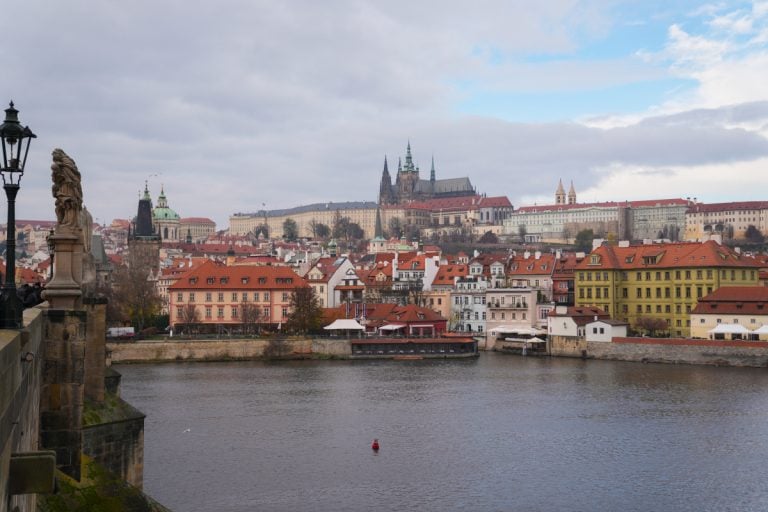
After two trips to Prague, I’m sharing my guide to the best things to do in this buzzing city in the Czech Republic. A city that, for me, feels equally romantic as it does historic. On my second visit, I found myself appreciating even more the extensive details of its baroque architecture, charming streets, and food scene. If you’re planning a trip to Prague, read on for my travel tips on what to see, where to stay, and the restaurants you can’t miss.
Ironically, I’ve been to Prague with both of my parents on two different trips. The first with my mom in 2015, and most recently with my dad in January 2026. It makes me chuckle that it worked out that way. On both of my trips to Prague, I found myself really appreciating this grand city.


Prague, or Praha, the capital of the Czech Republic, feels like a living gallery in some sense. Everywhere you look, there are Gothic spires and Baroque domes in the skyline. And, between them all, these stunning streets are lined with the most beautiful pastel-colored facades. Prague is beautiful to look at, and it’s equally interesting when it comes to culture and history.


From Old Town with its Jewish Quarter and churches, to the Malá Strana across the Vltava River, home to the Prague Castle, you can’t go more than a block before stumbling into centuries-old places. Combine that with a lively food scene, and you’ve got yourself one of the best cities to visit in Europe. And did I mention the beer? It’s usually cheaper than water at restaurants.


If you’re considering a visit to Prague, know that it’s well worth the journey to get there. With a few day trip options, several neighborhoods to visit, and plenty of historical sights to tour, you’ll have a proper few days’ worth to explore. This is my guide to the best things to do in Prague, with practical tips and insight into this gem of a city.
Short on Time? Here Are My Top Picks for the Best Hotels and Things to Do in Prague:
Things to Do
- Prague Castle Official Entry Ticket — This skip-the-line ticket lets you explore the castle at your own pace (valid for two days).
- Prague Castle Tour Including Admission Ticket — This is the highest rated guided tour of the castle (2.5 hours).
- Klementinum Library & Astronomical Tower Guided Tour — This 45-minute guided tour is a great way to see both the beautiful Klementinum Library and panoramic city views from the Astronomical Tower.
- Prague Jewish Quarter Walking Tour with Admission Tickets — A guided tour is the best way to get full context to the history here. This 2.5-hour guided walking tour through Josefov covering the historic synagogues and Old Jewish Cemetery is a great option.
- Český Krumlov Full-Day Tour from Prague — This highly-rated small-group day trip is an easy way to see one of the most beautiful medieval towns in Europe (see my guide to Český Krumlov).
Where to Stay
For the most walkable experience, I recommend staying in the Old Town or Jewish Quarter. For a quieter, more local neighborhood, I’d stay in Malá Strana.
Hotels
- Four Seasons Hotel Prague ($$$), for the best riverside luxury hotel
- Mandarin Oriental, Prague ($$$), for the best luxury hotel in Malá Strana
- Buddha-Bar Hotel Prague ($$), for the best design-forward boutique hotel
- Aria Hotel Prague ($$), for the best old-world stay
Airbnbs
- 2 Bedroom Apartment in the Jewish Quarter, for the best Old Town apartment
- 1 Bedroom Vintage Apartment with Fireplace, for the best located old-world apartment
- 1 Bedroom Apartment with Charles Bridge Balcony, for the best Malá Strana apartment
- 2 Bedroom Apartment in a Historic Windmill, for the best unique stay in a converted windmill
Helpful Guides to Plan Your Trip
For exactly how I’d spend my time in Prague, read my 3-Day Prague itinerary!
Travel Tip: Having mobile data is a must when traveling to Prague. We use Holafly unlimited data eSIMs (5% off!) for all international travel.
The Best Things to Do in Prague, Czech Republic
Prague Planning Tips Before You Arrive

Best Time to Visit Prague
On both of my trips to Prague, I’ve been there in the fall and have found it to be one of my favorite times. The weather is crisp, the leaves are all changing color, and the food is that much cozier. The second-best time to visit would be spring. If possible, I’d try to avoid peak summer (July and August) for the crowds and heat. Lastly, Prague can be quite magical in the winter, when the Christmas markets and decorations fill the city.

How Much Time Should You Spend in Prague?
On both of my trips, I spent four nights and felt it was the right amount of time in Prague. You can see the main sights of the city in two to three very fast-paced days if you’re tight on time, but giving yourself extra days will give you a lot more room. You’d be able to take a nearby day trip, hop on a tour, book in experiences throughout the city, and enjoy all of its neighborhoods. Read my Prague itinerary for how I’d spend my time.
Getting to Prague
The best way to arrive in Prague from elsewhere in Europe or the US is to fly into Václav Havel Airport Prague (PRG), about 30 minutes from the city center. The airport serves nonstop flights to dozens of major European airports, so you can easily visit as part of a larger European itinerary. If you happen to be in places like Vienna and Berlin, there are 4 to 5-hour direct trains that also arrive in Prague.

How to Get into Prague from the Airport
Do Not Get Scammed
I’m going to save you the headache of what I did on arrival, which was get scammed into paying over DOUBLE the price for what I thought was an official taxi. As you arrive at the luggage area in the airport, you’ll see signs everywhere saying “make sure you take an official taxi,” and follow the bright yellow line on the ground to the official taxi stand, because it is an ongoing issue. I did this, but when I came out of the double doors looking for a taxi, I was whisked away by a man in a yellow vest claiming he was an official taxi — but he took us to an outer edge of the airport street, and pushed us into a car that was a “taxi”. It was all very convincing that it would be official given his vest and all. I ended up paying more than double the normal taxi fare and got scammed. I will also note that I am a frequent traveler, and that’s how convincing this person was!
My Advice: Call an Uber or Pre-Book a Private Transfer with Welcome Pickups
The Ubers here are heavily regulated and actually have to be registered as airport Ubers in order to pick up, so they follow the correct rates. I used an Uber to get back to the airport, and it was less than half of the scammed taxi on the way in. So I recommend an Uber, or being very certain that you’re in an official taxi — it shouldn’t be more than $35 USD or around 500 CZK unless there is heavy traffic. (I paid a painful $90 USD for my scam taxi).
Alternatively, I’d also suggest pre-booking a private transfer with Welcome Pickups. My husband and I use them most of the time in Europe to get to and from the airport, and the drivers have always been on time and waiting for us with a sign at arrivals. A private transfer costs about twice as much as a taxi, but it’s always felt worth it.
Getting Around Prague

I’ve always found walking to be the most convenient way to get around Prague, as it’s a very compact city. You can easily go from the Old Town to Malá Strana on foot. I would wear some really great walking shoes; I clocked in over 20k steps daily. For longer distances in the city, I recommend:
- Uber — The most convenient and affordable option for door-to-door transfers in the city. They’re truly quite cheap. I took about a half-dozen when I just wanted to get somewhere quickly. I don’t think any of my fares were ever over $10 USD in the city center.
- Metro — Prague has 3 main metro lines (A – green, B – yellow, C – red). It’s considered safe and reliable, and the tickets are based on either 30- or 90-minute increments. There are also 24-hour or 72-hour passes. You can get tickets at the metro station by card or even download the local mobile metro app.
- Trams — There are a few tram lines that may be worth considering, such as Tram 22, which is great for reaching Prague Castle. It’s about $1–2 USD to get on, and there are contactless payment machines onboard.
Currency, Cash, and Credit Cards in Prague
The Czech koruna (CZK) is the official currency in Prague, not the euro. Some places will take euros but notoriously give horrendous exchange rates, so it is not worth it. Most places widely accept credit cards. I didn’t pull out any cash on my most recent trip. I do know there are a few select restaurants in the city that may be cash-only, so this is something you’ll want to confirm ahead of time.


Get Cell Data Before You Arrive
I never travel internationally without cell data and having it makes navigating Prague much easier. I use Holafly unlimited data eSIMs for all international travel and recommend installing your eSIM before arrival so everything works immediately when you land. Pre-purchase your Holafly eSIM here.
Other Helpful Tips
- Get up early — The crowds are pretty intense come mid-day, especially around Charles Bridge and Old Town.
- Make reservations in advance — Restaurants, tours, and popular sights book out far in advance. You need reservations for most things in the city.
- Learn a few Czech phrases — Knowing a few simple phrases like “Dobrý den” (hello) or “Děkuji” (thank you) is helpful, and the locals appreciate it
- Tipping — At restaurants, the most common practice is to round to the nearest convenient number (10% also works).
Where to Stay in Prague


After two trips to Prague, as I see it, the two most convenient places to stay are either near the Old Town or the adjacent Jewish Quarter (Josefov) or in Malá Strana (Lesser Town), just over the river. I find Malá Strana to be more of a local, charming neighborhood close to the Prague Castle Complex. Old Town is close to the downtown sights and in the thick of it. Both hotels and Airbnbs in Prague are wonderful choices, depending on your preference. I’ve included my favorites for both below.
Best Hotels in the Old Town
- Four Seasons Hotel Prague ($$$), for the best riverside luxury hotel
- Almanac X Hotel ($$), for the best Art Deco luxury hotel
- Buddha-Bar Hotel Prague ($$), for the best intimate boutique hotel
- The Emblem Prague Hotel ($$), for the best stylish hotel
- BoHo Prague Hotel, an SLH Hotel ($$), for the best design-forward boutique hotel
Best Airbnbs in Old Town
- 1 Bedroom Apartment on Old Town Square (Where I Stayed), for the best views
- 2 Bedroom Apartment in the Jewish Quarter, for the best spacious stay
- 1 Bedroom Vintage Apartment with Fireplace, for the best character-filled apartment
- 1 Bedroom Apartment with Old Town Square Views, for the best modern apartment
Best Hotels in Malá Strana
- Mandarin Oriental, Prague ($$$), for the best luxury hotel in Malá Strana
- Aria Hotel Prague ($$), for the best music-themed boutique hotel
- Augustine, a Luxury Collection Hotel, Prague ($$), for the best historic monastery hotel
- Hotel Nerudova 211 ($), for the best intimate stay
Best Airbnbs in Malá Strana
- 1 Bedroom Apartment with Charles Bridge Balcony, for the best views
- 2 Bedroom Apartment in a Historic Windmill, for the best unique stay
- 3 Bedroom Baroque Loft near Charles Bridge, for the best group or family apartment
- 2 Bedroom Riverside Apartment with River Views, for the best riverside apartment
The Best Things to Do in Prague, Czech Republic
Spend Time in Charming Malá Strana


For me, one of my favorite areas of Prague to spend at least a proper half-day in is Malá Strana. It has an almost fairy-tale feeling, with steep streets lined with historic Baroque architecture leading up to the Prague Castle Complex. Malá Strana has everything I love about Prague. The history, bustling cafes and pubs, elevated dining, shops, and more. It’s somewhere you really are going to want to time to visit slowly and well.

If coming from Old Town, I’d begin by crossing the Charles Bridge (Karlův most) over the Vltava River. As you get over the bridge and are facing the Statue of Bruncvík, take the stairs to the left and down to the Lennon Wall. The Lennon Wall is covered in constantly-changing graffiti and is one of Prague’s more notable modern landmarks. The colorful, layered graffiti art is a mix of political messages, peace signs, and Beatles-inspired art. Since it’s always changing, I like to stop by each time I visit.


From there, I’d head over to Mostecká Street, which is the main street running through the neighborhood. The street is home to dozens of restaurants and cafes. Three Golden Stars is my personal favorite here for classic Czech food.
While in Malá Strana, this is the time to visit more of its historic sights. I’d look to visit:
- The Vrtba Garden, a famous, terraced, 18th-century garden that is a total hidden gem, is tucked away on a side street.
- St. Nicholas Church (Malá Strana), a 17th-century Baroque church
- Prague Castle Complex, home to the castle, St. Vitus Cathedral, Old Royal Palace, and Lobkowicz Palace (more below).
- Strahov Library, a historic library with ornate Baroque halls and rare manuscripts (advance ticket and tour required to visit).
- Waldstein Garden, a formal Baroque garden with fountains, statues, and peacocks
Visit the Prague Castle Complex

The grand jewel of Prague and one of the most famous landmarks on its skyline is the Prague Castle Complex (Pražský Hrad). There is more to do here than one thinks because the Prague Castle Complex comprises so much. Recognized as the largest ancient castle complexes in the world at over 750,000 square feet, you’re going to want to allow for 3 to 4 hours just to visit the castle complex.


Travel Tip: If you already know you want to visit the castle complex and want to skip the information below, know that the official online advance ticket is available on Get Your Guide. I’d highly recommend getting your tickets ahead of time. It also has free cancellation, which is lovely in case of last-minute changes.

I’m going to break down the best way to approach the Prague Castle Complex, which sights not to miss, and how to handle tickets and tours. Start at Hradčany Square to approach the castle. The entrance is just down the left side when looking at the Matthias Gate, where you’ll get tickets if you didn’t buy them in advance.
I’m going to break down the best way to approach the Prague Castle Complex, which sights not to miss here, and how to handle tickets and tours. The first step is to begin at Hradčany Square to approach the castle. The entrance is just down the left side when looking at the Matthias Gate, which is where you’ll get tickets if you didn’t in advance and decide on tours.


The Main Sights of the Prague Castle Complex You’ll Want to Visit
- St. Vitus Cathedral, iconic Gothic cathedral with stained glass and royal tombs
- Old Royal Palace, historic medieval palace with the grand Vladislav Hall
- St. George’s Basilica, Romanesque church, one of Prague’s oldest
- Golden Lane, colorful historic houses once home to castle guards and artisans
- Lobkowicz Palace, museum with an art collection and Beethoven exhibits
- The Royal Garden, terraced gardens with panoramic city views
For Tickets to Prague Castle, You Have Two Choices:
- Main Circuit (The One I Recommend) — The Main Circuit ticket includes one-time entry into the Old Royal Palace, St. George’s Basilica, Golden Lane, and St. Vitus Cathedral.
- Circuit B / Permanent Exhibitions — This is really for those interested in history who’d like to see a few additional exhibitions, such as the Castle Guard and the Prague Castle Picture Gallery. I personally would focus on the Main Circuit.
The hack for skipping the typical massive lines that queue up for tickets is to pre-purchase the only official digital ticket on Get Your Guide. This gives you a digital QR code that will give you one-time access to each of the included Main Circuit sights. Ticket costs for the Main Circuit are ~450 CZK for adults, 300 CZK for seniors/kids/students, and 950 CZK for a family of 2 adults and up to five children.


Best Ways to Visit the Prague Castle Complex
You can easily walk through all of these sights on your own, but you will certainly miss out on the historic importance, architectural elements, and defining details of what makes this Prague Castle so important. I have visited twice now. The first time, I joined a tour and learned so much. I highly recommend that, for a first-time visit, you take a tour. Here’s what I would do and in which order if visiting on your own:
- Stop 1: St. Vitus Cathedral
- Stop 2: Old Royal Palace
- Stop 3: St. George’s Basilica
- Stop 4: Golden Lane
- Stop 5: Lobkowicz Palace
For Tours, there are two approaches for Prague Castle
- Book a private or group tour on Get Your Guide or Viator with a local guide (the simplest option with the most flexibility)
- Book one of the official Prague Castle Guides, which is 250 CZK per person per hour. These tours are typically 2 to 3 hours, and require a minimum of 4 persons, booked in advance in your preferred language on the Prague Castle website — these are group tours.
Personally, I’d opt for the ease of a tour from one of the tour suppliers, as it’s much easier to book. The ones I recommend are:
- Prague Castle Tour Including Admission Ticket — 2.5 Hour (highest-rated)
- Small-Group Tour of Prague Castle with a Local Guide — 2.5 Hour (highest-rated small group)
- Private Prague Castle Walking Tour — 3-Hour (highest-rated private tour)
- Prague 3-hour Afternoon Walking Tour including Prague Castle — 3-Hour
Stroll the Charles Bridge

Charles Bridge, for me, feels like quintessential Prague. I’ve been there at sunrise and sunset, midday, and have seen it early, empty, and shoulder to shoulder in crowds. It’s one of the most important sights in the city, sitting over the Vltava River. Charles IV had it built in 1357, and it was completed in 1402, so it’s quite important to the city’s history.
Two towers sit on either end of the bridge. The first is the Old Town Bridge Tower (East side), which is an absolute Gothic masterpiece. Then the Lesser Town (Malá Strana) Bridge Towers (West side), which have two connected towers, a large Gothic tower and a smaller Romanesque tower, were built to protect the bridge and guard the road to Prague Castle.

Along the bridge, you’ll find 30 statues and sculptures, each dating back to the 17th-18th centuries. The most notable is St. John of Nepomuk, who is said to bring luck when touched. It’s a very popular sight to visit, and a thing to do in Prague, so keep this in mind when you visit.

Travel Tip: If I had to pick my ideal time to photograph the bridge, I would go at sunrise. It will be you and a handful of photographers with tripods, taking the famous photo of the bridge, looking back into the old town. Now, if you want an iconic photo of the bridge itself, I would walk behind the Four Seasons Hotel to the Vltava Castle Viewpoint for the best view.
Visit the Jewish Quarter and Get the Jewish Museum Pass

One of the most important parts of Prague’s history is in the Jewish Quarter. Known as Josefov, this compact historic district is one of the most significant Jewish communities to have endured the 20th-century Nazi occupation. But the history goes far beyond that, starting in the 13th century when Jews were ordered to vacate their homes and live solely in this part of town. As the area survived centuries of occupation, the synagogues and buildings form the best-preserved complex of historical Jewish monuments in Europe.
Important Note: Choosing to visit the Jewish Quarter and its important sights is choosing to visit the solemn and turbulent past of the Jewish community in Prague. Please do so with respect and dress appropriately to enter their religious sites.


The Jewish Quarter has six synagogues, including the Spanish Synagogue, the Maisel Synagogue, and the Old-New Synagogue, plus the Old Jewish Cemetery and the Jewish Ceremonial Hall. All of these are part of the “Jewish Town monuments,” which requires a Jewish Town Ticket. You can purchase one at the Jewish Museum Information Centre or at your first site entrance. Tickets are 600 CZK (€24) for adults, 400 CZK (€16) for students under 26, and 200 CZK (€8) for children aged 6–15.
The Jewish Quarter has six synagogues, including the Spanish Synagogue, the Maisel Synagogue, the Old-New Synagogue, the Old Jewish Cemetery, and the Jewish Ceremonial Hall. All of these are part of the “Jewish Town monuments” which requires a Jewish Town Ticket, available for purchase at the Jewish Museum Information Centre, or you can get one at your first site entrance. Tickets are 600 CZK (€24) for adults, 400 CZK (€16) for students under 26, and 200 CZK (€8) for children aged 6–15.
The Main Jewish Town Sights
- Old-New Synagogue, Europe’s oldest active Gothic synagogue, still in use today
- Spanish Synagogue, Neo-Moorish interior with Jewish Museum exhibits
- Maisel Synagogue, historical artifacts and ceremonial Judaica collection
- Pinkas Synagogue, Holocaust memorial with the names of Czech victims inscribed on the walls
- Old Jewish Cemetery, layered medieval gravestones in one of Europe’s oldest cemeteries
- Klausen Synagogue & Ceremonial Hall, Baroque synagogue with exhibits on rituals and traditions

If you’re choosing to self-tour, my recommendation is to download the free app created by the Jewish Museum. This free app has an audio guide for each site you visit, which is easy to follow and provides important historical context for what you’re seeing. It took me about 2.5 hours to get through all of the sites while listening to the audio guide. It is free, and someone at the desk can help you set it up.
That said, my dad, whom I traveled with, ended up going on an additional guided tour of the Jewish Quarter. Unfortunately, I couldn’t go, and I wish I had opted for a guided tour because there is so much to understand and learn from a guide. The Jewish Quarter walking tour I recommend is this one.
See the Old Town Square

The liveliest square in Prague is the Old Town Square. Lined by some of the most beautiful Gothic, Baroque, and Romanesque buildings, this is the spot to cross through a few times. While I do find the Old Town Square quite overwhelming in crowds by late morning, there is nothing better than an early morning stroll through.
The square really is one of the most beautiful I’ve seen in Europe. The most notable building there is the Church of Our Lady before Týn, which faces the Town Hall and is famous for its Gothic twin spires and Baroque altars. Across from it is the Prague Astronomical Clock Tower, famous for the display of twelve apostles when the clock strikes.


The Old Town Hall is just adjacent to the Astronomical Clock Tower, and has panoramic views over Prague — it’s one of the best towers to go to the top of for views. And then to the northwest corner of the square, you’ll find St. Nicholas Church, with a stunning facade that dates back to the 12th century.
This area is absolutely jam-packed by late morning and into the early hours of the night. You’ll find restaurants pouring out into the streets, street performers around the Jan Hus monument at the center of the square, and so much more here.
Find the Best Views From One of the Towers


I hinted at the incredible views you can experience in Prague from one of its many towers earlier. I’d recommend doing it at least once or twice while in Prague, because the skyline here is stunning.
If I had to pick my top two, it would be the Clementinum Astronomical Tower (different from the Prague Astronomical Clock Tower) and then the Old Town Hall Tower. I love the Clementinum because it includes access to the library and has views of Prague Castle. The Old Town Hall Tower has the best views of the Prague city center itself and its iconic Baroque architecture.
The Best Towers to Visit
- Old Town Hall Tower
- Clementinum Astronomical Tower
- Old Town Bridge Tower
- Lesser Town Bridge Tower
- Powder Tower
- St. Nicholas Church Bell Tower
Watch the Prague Astronomical Clock Change on the Hour


A classic experience, and something I’d only do if it’s convenient, is to see the Prague Astronomical Clock change. The clock performs it’s famous mechanical show every hour on the hour, typically between 8 am and 11 pm. What you will see is two tiny doors open, then the twelve apostles march past the windows in procession, around the dial, animated figures like Death (a skeleton) ring a bell, while other statues (a Turk, Vanity, and Greed) move, and then a golden rooster at the end crows, and the big bell chimes.
It draws a crowd, and for good reason, as it’s a centuries-old tradition that has been taking place here in the Old Town Square. And while everyone watches this fun animated performance, I think not as many people understand what the astronomical clock actually is.
The clock was installed in 1410 and is the third-oldest still operating in the world. What makes it particularly interesting is how it combines timekeeping with astronomical data. Think of it as a medieval analog computer that has managed to survive centeries of war and far, including being damaged during World War II.
Book a Visit to the Clementinum Library

The Clementinum Library (Klementinum Library), is one of the hardest reservations in the city to get because it’s very small tours, and I managed to get one this last trip. I was so excited for the chance to see what is considered the most beautiful library in the world. I can’t stress enough to book this first, once you know your dates!
The Clementinum Library is part of a large baroque-era complex in Prague. Originally a Jesuit college, the complex now houses the National Library of the Czech Republic. The main attraction is the Baroque Hall, which you reach by climbing a set of stairs. Inside, the library holds over 20,000 historic volumes dating back to the 16th–18th centuries, including books from Johannes Kepler, early maps, and more.
The Clementinum Library is part of the Clementinum complex, a large Baroque-era collection of buildings in Prague. Originally a Jesuit college, the complex now houses the National Library of the Czech Republic, and the Baroque Hall, in which you climb up stairs to see is the main attraction. The libarary is home to more than 20,000 historic volumes, most of which date back to the 16th-18th centuries. The collection includes notable books from Johannes Kepler, early map Inside the Clementinum Library, it houses over 20,000 historic volumes dating back to the 16th–18th centuries, including early maps and books from Johannes Kepler.


As part of your ticket and visit, you also get to ascend the Astronomical Tower, which has the most incredible panoramic views of Prague, which makes it a wonderful two-for-one visit. I happened to time it with sunset this trip, and it was one of the most spectacular visits. Just know you’ll have to go up 172 steps, no elevator.
How to Get Tickets to the Clementinum Library
- Tickets: Advance tickets for timed entry only. Purchase tickets here
- Prices: Standard Tour Prices: Adult: ~380 CZK (~€14–€16), Reduced: ~230 CZK for children ages 6–15 and seniors 65+, Youth (16–26): ~300 CZK (reduced youth fare).
Try the Local Food and Beer

For me, one of the highlights of visiting Prague is the chance to get to eat the local food and try the local beer. The food and drink in Prague are fantastic; I feel like it’s highly underrated in terms of European food. I’d make the point to choose a few classic and traditional restaurants from the list below to try the local dishes. My personal favorites that I get every trip are Svíčková (beef in creamy sauce with bread dumplings) and the garlic soup, called Česnečka
Some of the Czech dishes I’d try
- Svíčková, marinated beef sirloin with creamy vegetable sauce, served with bread dumplings
- Vepřo knedlo zelo, roast pork with sauerkraut and dumplings
- Guláš, Czech-style beef stew, thick and savory, often served with dumplings or bread
- Bramboráky, potato pancakes with garlic and marjoram, sometimes served with sauerkraut or meat
- Knedlíky, Czech dumplings made from bread or potatoes, a staple side for meats and sauces
- Pečená kachna, roast duck, typically served with red cabbage and dumplings
- Řízek, breaded and fried meat cutlet, usually pork or chicken, similar to schnitzel
- Česnečka, garlic soup with potatoes, sometimes garnished with cheese or croutons
- Koláče, sweet pastries filled with fruit, poppy seeds, or cheese
- Trdelník, a sweet rolled pastry, grilled and coated with sugar and nuts, often sold as street food

When it comes to beer in Prague, know there are a hundred ways to try it. Beer is a big part of Czech culture, so I definitely recommend experiencing it. Surprisingly beer is usually cheaper than water in many local pubs. You’ll find beer halls across the city, dozens of options on restaurant menus, and even a beer spa where you can soak in the grain.
Some of the Czech beers I’d try
- Pilsner Urquell, the original pale lager from Plzeň
- Budweiser Budvar, a traditional Czech lager from České Budějovice
- Staropramen, Prague-based lager
- Kozel, beer with a mild malt flavor, available in dark and light
Take a Day Trip to Český Krumlov

The first time I went to Prague, I took a day trip to Český Krumlov, and it ended up being one of my favorite things I did the entire trip. This UNESCO World Heritage site in South Bohemia is so stunning. There’s a handful of things to do while there, so you’ll want the better part of a day to visit.
I took a day trip to Český Krumlov the first time I went to Prague and it end ended up being on of my favorite things I did the entire trip. The town is so stunning and a UNESCO World Heritage site. There is a handful of things to do while there, so you’ll want the better part of a day to visit.
To get to Český Krumlov, you have two options:
- Take the public bus (3 to 3.5 hours) and self-explore — It leaves from Prague Florenc bus station, and is around ~200–300 CZK (~€8–€12) one-way.
- Hop on a group or private day tour — This is best if you want something more tailored with a guide and to have your transport pre-arranged. The affordable options are limited, with this full-day, small-group tour with pickup and this highly-reviewed full-day tour being the best options.
Once in Český Krumlov, you’ll spend all of your time on foot getting to explore the medieval streets and visit the famous castle. In town, there are dozens of restaurants and beer halls. I ate at Bistro 53 Beer Point for a quick meal. It’s home to Český Krumlov Castle, the second largest castle complex in the Czech Republic (after Prague Castle), so be sure to visit this as well before or after time in the Old Town.
Visit the National Museum and then Stroll Wenceslas Square

On my first trip to Prague, I completely skipped the National Museum, and this time I made a point to get there. I regret not going the first time, as it was so incredible. It’s a massive deep dive into natural history, archaeology, history, and more.


The museum sits at the top of Wenceslas Square, overlooking the city. One of the big draws to visiting is the interiors themselves, with stunning grand staircases and these ornate halls on each floor. My favorite room in the museum was the mineral room, which showcases a massive collection of Czech and global minerals, crystals, gemstones, and meteorites in illumnicated cases.

After visiting the museum, I would go for a stroll through Wenceslas Square. Know that right now, there is heavy construction happening as they’re repairing parts of the square. The square is home to dozens of big-brand stores and restaurants, so there’s a lot to see while here.
National Museum Visitor Info
- Opening hours: Typically 10:00–18:00 (varies by section)
- Tickets: Around 250 CZK (~€10–12) for adults; reduced rates for students and seniors
Peep the Whimsical Architecture at Dancing House

If you happen to be in the Prague 2 district, don’t miss the chance to walk by the Dancing House. It’s an architectural wonder in the city, created by the architects Vlado Milunić (Czech) and Frank Gehry (Canadian-American) in 1996. The building has this whimsical facade, with a glass tower and a stone tower. It’s something you can easily walk by and see in a matter of a few minutes!
See a Classical Concert in Prague
If you’d like to experience a classical concert set in a stunning setting, there’s no better place than Prague. I had no idea these were available until I walked by one happening, and it was too late. There are four places you can enjoy classical works performed:
- Lobkowicz Palace Concert
- Classical Concert in Spanish Synagogue
- Organ Concert in St Francis Church
- Classical Concert in St. Nicholas Church
Catch the Havel’s Market (Havelské tržiště)

I’m always a big fan of catching a local market when visiting a new city, and Havel’s Market in Prague is it. It’s between Wenceslas Square and Old Town Square along Havelská Street, and dates back to the 13th century, making it the oldest continuous market in the city.
The market is open seven days a week, and the stalls typically open around 8 AM or so in the morning. There are lots of fruits, vegetables, dried nuts, and so on to enjoy here. It’s small, so about 30 minutes is all you need to stroll through and see if anything catches your eye.
Enjoy the Green Spaces along the Vltava River

The Vltava River cuts through the heart of Prague, dividing the city into two definable parts. Along its banks, several green spaces to enjoy when you want to get a view or spend time in the park. If you’re traveling with kids, these parks are great for getting some energy out.
Best Parks in Prague
- Kampa Park — This is the most scenic, riverside park on the banks of the Malá Strana side of Prague. It’s home to Museum Kampa and has several green areas to enjoy there, alongside a handful of restaurants.
- Letna Park — One of my favorite parts of Prague to catch the sunset and have a beer is at Letna Park. It has incredible views of the city, and it’s a large park here. There are kids’ playgrounds, paths, and benches to enjoy the views. But what I would do is do like the locals, and go to Letná Lookout Beer Garden (Letenský zámeček a zahrádky na Letné). I’d go at sunset, get a beer, and hang out until sundown.
Spend Time in the Trendy Vinohrady Neighborhood


On my first trip to Prague, I spent a few nights in the Vinohrady neighborhood. It’s a very residential neighborhood with a handful of cafes and local restaurants. It comes sans the crowds, and a breath of fresh air for a local feeling. The main Náměstí Míru (Peace Square) is the heart of it, and is home to the Church of St. Ludmila.
If you’re coming this way, I’d go to a few places to eat. The first is to go to La Bohème, a local cafe and coffee roastery. Cafefin Coffee is also in this neighborhood. For food, Kro Kitchen is one of the best spots in this neighborhood, and Brambory is upscale for creative dishes.
A Few More Things to Do in Prague
- Take a Vltava River Cruise, most are 1-hour and a great way to see some of the main sights from the water
- Climb Petřín Hill, for panoramic views of the city
- Take a Day Trip to Kutná Hora and see the Bone Church
- Find the David Černý Sculptures Around the City, the Franz Kafka Rotating Head is probably the most famous
- Explore the Vyšehrad Fortress
The Best Restaurants in Prague, Czech Republic
There is so much good food in Prague, but know that the popular restaurants most certainly need a reservation. Here’s where I’d go:
420


Set in a stunning building with an open hall, 420 is all things modern Czech. They pay homage to traditional cuisine, but with a fresh twist. I had one of the best schnitzels of my life here — I’d go back just for this dish.
Lokál Dlouhááá


If I had to pick only one restaurant to eat at, it would be Lokál Dlouhááá. The very hip and industrial beer-hall style restaurant is all you can hope for in a Czech dining experience. You absolutely need a reservation any day of the week; it’s always packed. Their beer is fantastic, the service was great, and you can try a handful of dishes here, like chicken schnitzel and the boiled beef neck.
Café Imperial
A longstanding institution, Café Imperial has a grand dining room. I went here my first trip for an early breakfast, it’s a really lovely and elegant place to dine. It’s open for every meal of the day.
Naše Maso
A total gem of a spot. Naše Maso is listed as a “ham shop” on Google Maps, but it is so much more. It’s a full deli, but with an extensive dining menu from wagyu burgers to sausages. It’s one of the most popular spots in the Jewish Quarter, so be prepared for some lines.
Three Golden Stars (U Tří Zlatých hvězd)


Over in Malá Strana, Three Golden Stars is a no-thrills, fantastic local eatery. It’s very classic cuisine, served as such. You’ll get everything from goulash with dumplings to vepřové koleno and onion soup. You can reserve, but I think you’d be pretty safe to walk in mid-week lunch without a reservation.
Bredovský Dvůr
Bredovský Dvůr is all things classic Czech beer hall meets restaurant — you come here for a good time, hearty food, and endless beer. The pork knuckle is the main star, and don’t skip the apple strudel.
Trdelník – Sweet Chimney Cake near Charles Bridge


One of my favorite treats I get when in Prague is Trdelník, these fire-roasted doughs, tossed in a variety of toppings. My favorite is the cinnamon sugar, a classic to what is a very traditional street food in Czech Republic. Now days in Prague, there are shops all over, some putting ice cream and doing fun twists.
Kuchyň
You’ll need a reservation to eat at Kuchyň, this elevated restaurant in Malá Strana. It’s a very chic spot, specializing in classic Czech food, but more modern and refined. Kuchyň also has one of the best views looking back to the city, so ask for a table by the window.
5th District Restaurant & Cafe by King Solomon
A lovely Jewish restaurant that feels both modern yet does classic dishes. From hummus with falafel to bagels with smoked salmon, it’s a good local spot.
Restaurace Mincovna

One of the most popular spots for old-fashioned dining in Prague, I went to Restaurace Mincovna on my first trip, and it was just as busy this time. It’s all things Czech, with very cheap beer and hefty portions. You can get traditional beef goulash here, beef tartar, and even get the local trout.
Restaurant Mlýnec
I had spotted Restaurant Mlýnec when I was walking along the river, and upon further investigation, found out this was a total top spot in the city. It serves refined Czech cuisine and has the most beautiful window views of Charles Bridge. You’ll need a reservation in advance; it was booked up the week I was there.
Where I Would Grab a Coffee


- The Miners Coffee Charles Bridge
- Onesip Coffee
- Bond Cafe
- Nerudova 211 Café
- Coffee Room Celetna
- Kafe Damu
- Spell Coffee
FAQ: Visiting Prague
- How many days do you need in Prague? 4 nights will give you enough time to see the main sights and take a day trip. See my Prague itinerary for more details.
- Is Prague expensive? No. Prague is one of the most affordable major cities in Europe.
- Is Prague Walkable? Yes. The city is very compact and all the main sights are mostly within walking distance.
- Is Prague safe for tourists? I’ve always felt safe walking around Prague, both during the day and at night.
- What’s the best time to visit Prague? Fall is my favorite time to visit, though Spring is also great. I’d try to avoid the peak summer crowds if you can.
- Do you need to book things in advance in Prague? Yes, absolutely. The popular restaurants and sights all book up well in advance.
- What currency does Prague use? The Czech koruna (CZK), not the euro
Save This Post for Later on Pinterest


PS — Are You Booking a Trip Soon? Use My Booking Checklist!
These are the sites I use most to book my own trips. Using the links below is a great way to support Bon Traveler’s travel journalism at no extra cost to you. If you need help organizing your itinerary, get my free travel itinerary template here.
1. Book Your Accommodations
I use Booking.com for hotels and Airbnb for vacation rentals. They have the biggest inventory and consistently offer the best rates.
2. Book Your Rental Car
Self-driving is the best way to explore most destinations. I use Discover Cars for our rental cars, select full coverage insurance, and opt for a reputable company like Alamo, Hertz, or Sixt.
3. Book Your Tours & Experiences
I use Viator, Airbnb, and Get Your Guide to find the best tours and experiences. They are my favorite tour search engines. I always check all three as their inventory varies depending on the destination.
4. Book Your Private Transfers
For easy, reliable private transfers, I use Welcome Pickups. It’s my go-to for arranging a driver in advance — whether it’s an airport pickup, a hotel-to-hotel transfer, or a day trip. The experience is seamless, with English-speaking drivers and upfront pricing, so you can travel stress-free at every stage of your trip.
5. Get Cell Data for Your Trip
I use Holafly for international cell data. Their unlimited data eSIMs are easy to install, activate instantly on arrival, and let you skip local SIM cards and expensive roaming fees.
6. Don’t Forget Travel Insurance
I never leave the country without travel insurance. It provides comprehensive protection in case anything goes wrong (ie. illness, injury, theft, or cancellations).
My favorite companies that offer the best coverage and rates are:
- World Nomads (best for all-around)
- Safety Wing (best for frequent travelers)
Xx,
Jessica